Leave “How many” empty if you can buy as many as you need. With prices, the cheapest mix is found.
Paste parts from Excel
Looking for the best layout…
Saved in this browser — your lists stay on this device. Nothing is sent anywhere.
About the Cut List Optimizer
A sheet of good plywood is expensive, and a wrong cut cannot be taken back. With ten or twenty parts it is hard to see how they fit best — by hand, one sheet too many is normal.
Type the sheets you have or can buy and the parts you need. The optimizer tries many thousand layouts and shows the one with the fewest sheets and the biggest offcuts left over, as a cutting diagram for each sheet. Print it and take it to the saw, or show it to the shop that cuts for you.
Features
- Sheets and bars — plywood, MDF, glass, acrylic; timber, pipes and profiles
- The saw blade counts — every cut takes its kerf from the wood
- Straight cuts only — every cut goes from edge to edge, as on a table saw or panel saw
- Grain — keep the direction for all parts or for some of them
- Several sizes — with a number you have and a price; the cheapest mix is found
- Inches with fractions — 23 1/2, 3'6" — or mm and cm, with conversion
- Paste from Excel — name, length, width, quantity
- PDF, print and CSV — 4 styles, with a parts table
- Private — worked out on your device, nothing is uploaded
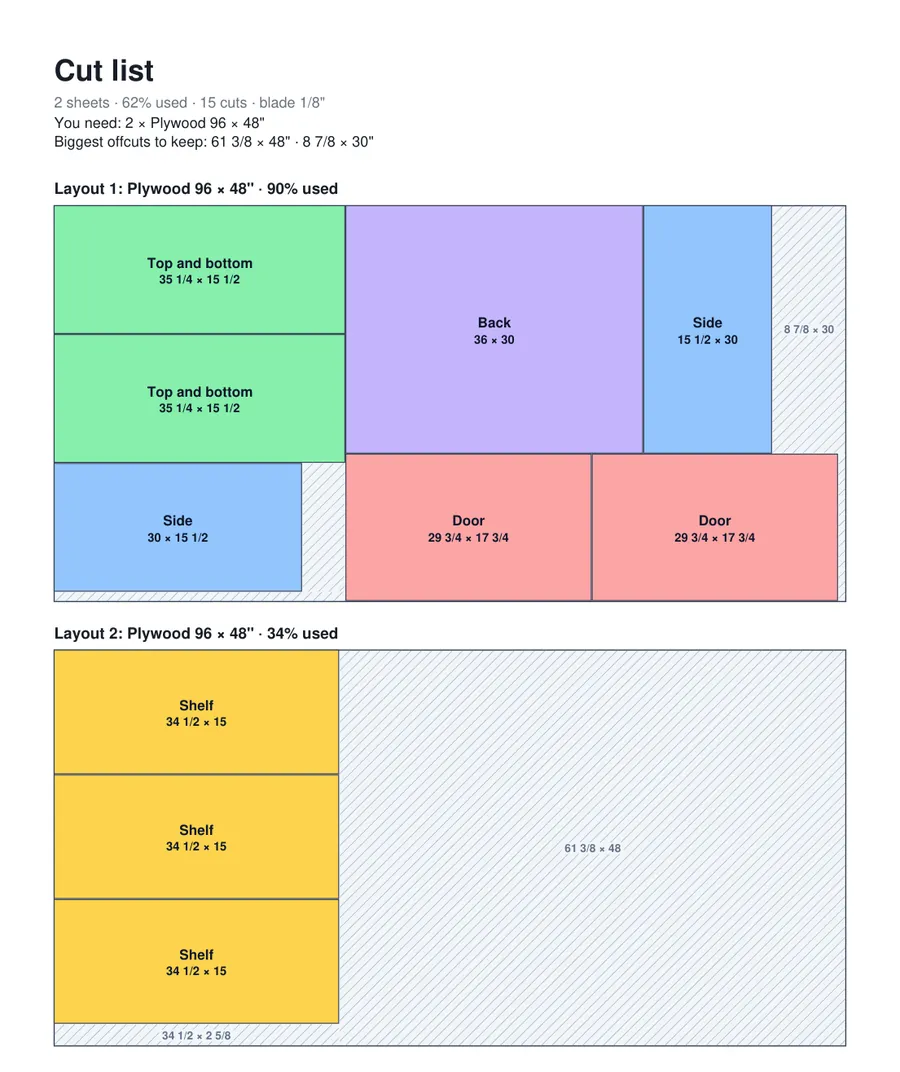
Plywood cut list example
A small cabinet from 4 × 8 ft plywood: ten parts, two sheets, and one big offcut of 61 3/8 × 48″ left over for the next project.
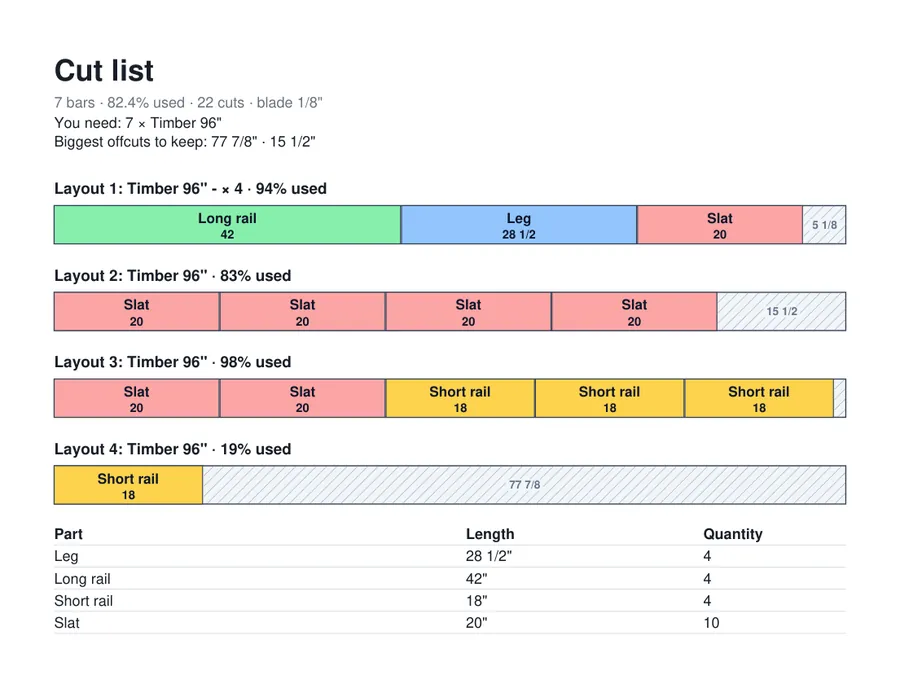
2x4 cut list (linear)
Choose Bars for lumber, pipes and trim. Each bar shows its parts in a row:
How many equal pieces come out of one 8-foot board (96″) with a 1/8″ blade:
| Piece | Pieces from 96″ | Left over |
|---|---|---|
| 12″ | 7 | 11 1/8″ |
| 16″ | 5 | 15 3/8″ |
| 18″ | 5 | 5 3/8″ |
| 24″ | 3 | 23 5/8″ |
| 30″ | 3 | 5 5/8″ |
| 32″ | 2 | 31 3/4″ |
| 36″ | 2 | 23 3/4″ |
| 48″ | 1 | 47 7/8″ |
The surprise is 24″: four pieces and three cuts need 96 3/8″, so the fourth piece is too short. Mix it with other lengths, and the optimizer uses the rest. Real boards are often a little longer than 96″ — measure yours.
Kerf: why the last part does not fit
A saw blade turns wood into dust. With a 1/8″ blade, eight strips of 6″ do not come out of a 48″ sheet: seven cuts take 7/8″.
| Saw | Typical kerf |
|---|---|
| Table saw, full blade | 1/8″ (3.2 mm) |
| Table saw, thin blade | 3/32″ (2.4 mm) |
| Track saw | 1/16″ to 3/32″ (1.8–2.2 mm) |
| Circular saw | 1/16″ (1.6 mm) to 3/32″ |
| Hand saw | 1/32″ to 1/16″ (1–1.5 mm) |
| Glass cutter | 0 |
Measure your own blade: make a cut in a scrap and measure the gap.
Common sheet sizes
| Material | Size |
|---|---|
| Plywood, MDF, OSB in the US and Canada | 48 × 96″ (4 × 8 ft) |
| Baltic birch | 60 × 60″ (1525 × 1525 mm) |
| Plywood, MDF in Europe | 2440 × 1220 mm, 2500 × 1250 mm, 2800 × 2070 mm |
| Half sheet | 48 × 48″ (1220 × 1220 mm) |
Cut off each edge is for rough factory edges: 1/4″ (5–10 mm) on each side gives clean, square edges.
Tips for the saw
- Read a layout from the long cuts. First cut where a line goes through the whole sheet, then divide the pieces
- Cut parts of the same width with the same fence setting, one after the other
- Cut the big parts first, while the sheet is still easy to hold
- Add a little to parts that will be planed or edged later
- Parts with visible grain — doors, drawer fronts — get a tick under Grain. The length of the part then follows the length of the sheet
- Write the part name on each piece as you cut
Frequently asked questions
Is the result always the best possible?
Nobody can promise that: with many parts there are more layouts than any computer can try. The optimizer tries thousands per second and keeps the best. Press Try 6 seconds more to look further — often nothing better exists.
Why does it use straight cuts only?
A panel saw and a table saw cannot stop in the middle of a sheet. Layouts with steps inside would fit a little more, but only a CNC router can cut them.
Can I use leftover pieces?
Yes. Add each piece as a size and type how many you have. Give them a low price and they are used first.
How do I enter fractions?
Type 23 1/2 or 23-1/2, or with feet 3'6". Decimals work too: 23.5.
How are the bars cut?
Choose Bars. Every bar shows its parts in a row with the length that is left over. Equal bars are shown once, with "× 4".
Is it a linear cut list calculator too?
Yes. Bars (timber, pipe) is the linear mode: only lengths, several stock lengths, prices, and the saw blade.
What size is a 4 × 8 sheet?
48 × 96 inches, 1219 × 2438 mm. Choose it under Common sizes.
How many parts can I enter?
Up to 1,500 pieces. Big lists need a little longer.
Related tools
- Square Footage Calculator — the area of a room or a board
- Unit Converter — inches, feet, mm and cm
- Inches to cm — one value or a whole list
- Tile Calculator — tiles for a floor or a wall
- Paint Calculator — paint for the finished piece
How to use it
- Choose Sheets or Bars and your unit
- Type the saw blade (kerf)
- Type the sizes you have or can buy, with price if you like
- Type the parts — or paste them from Excel
- Tick Grain for parts that must not turn
- Look at the diagrams, then print them or download the PDF